The Minolta XP: my dream ultimate manual focus analog camera that will never exist

I have a knack for companies and manufacturers that have made incredible products and advanced science, but have gone under as a result of mergers, market failure or plain capitalism. One of those companies is Minolta. Born as a cooperative venture between the Japanese and the Germans, Nichidoku Shashinki Shōten started in 1928 with the production of 120 folders, but expanded with different formats and builds of cameras. After several name transformations, the company settled on Minolta in 1962. In my experience, these camera’s might be the finest work of photographic technology ever commercialized. The excellent craftsmanship and technological advances of the Japanese industry with the precision and experience of German science.
My current experience
I love the last lines of Minolta cameras the best. The X700 and X500 are excellent and along with the XD7, might be the most elegant and amazing cameras I have used. Yet, there is no Minolta camera that satisfies all of the features of the manual camera I want. Some features that are present on one camera are missing from another, even though the cameras themselves are Dieter Rams-complete (read: following the 10 principles of good design).
I have some experience with the X500 and X700. I don’t have a lot of experience with the XD-7. This is important, because I want to get better at using manual settings in my camera, whilst maintaining the option for programmed modes. I do highly suspect that my opinion will change as I get better at analog photography.
The Minolta XP: specifications
The base
I think the ultimate base to start with would be the XD7. Its full-metal body and elegant construction, along with knobs and settings exactly where you need them. The black version is incredible - it really lets the camera be a harmonious instrument, without being obtrusive or boring. The X500/X700 do add a lot of support with the bump grip. Although the more common modern DSLR design is significantly more ergonomic, is has less character. Since external grips exist, I prefer the more classic SLR style over the modern DSLR style.
The internals
The internals would combine the features of the XD-7, the X500, X700 and some other cameras in a single feature set. From each camera we will take:
- SR-T 101, SR-T 202, SR-T 303 lines
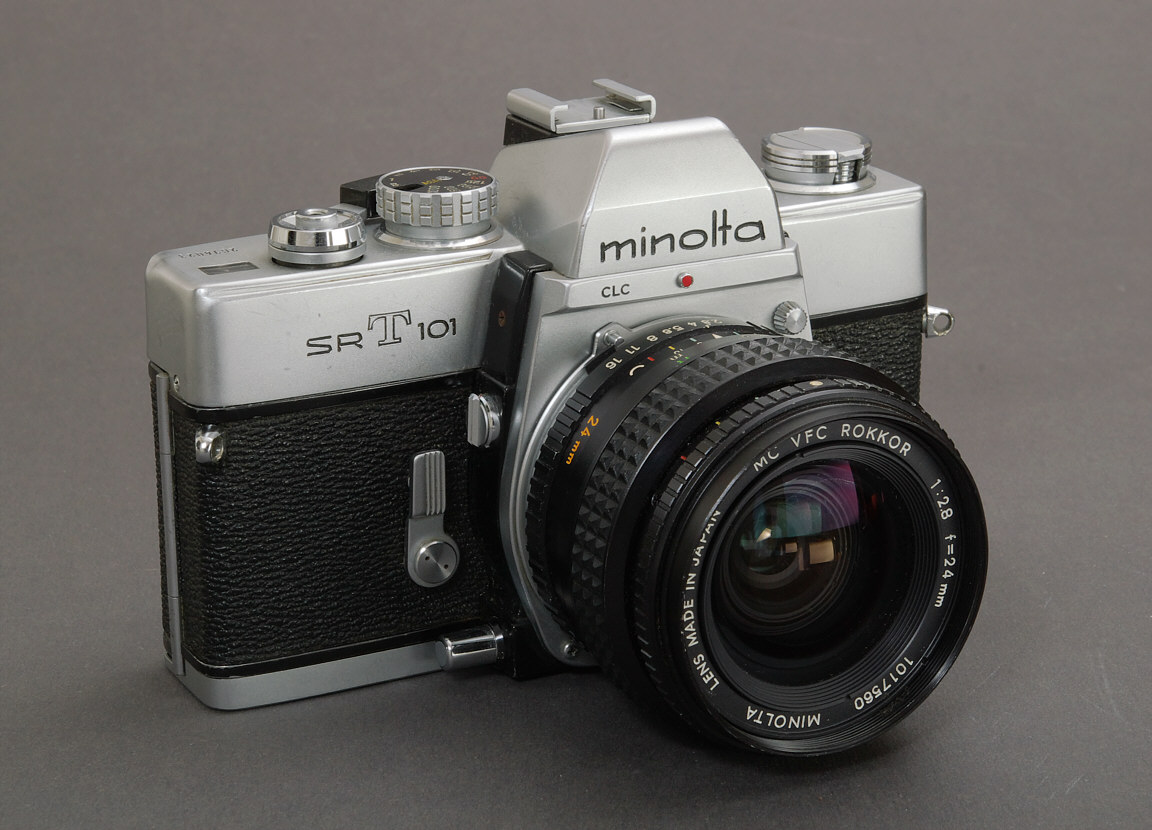
- Mirror lock-up
- Advance lever action
- XE-1
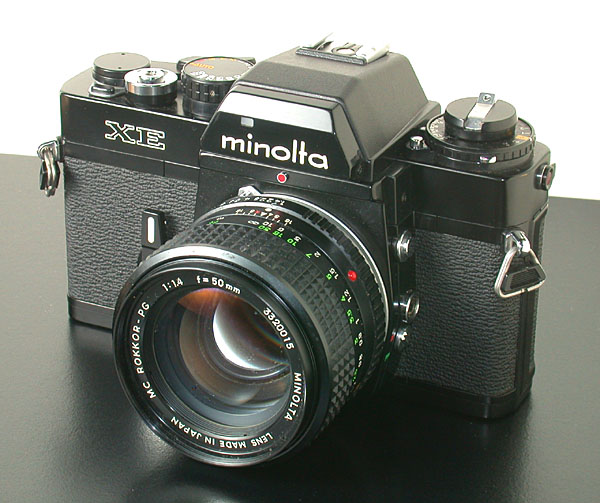
- Multiple exposure
- 40 ms shutter button lag
- XD-7
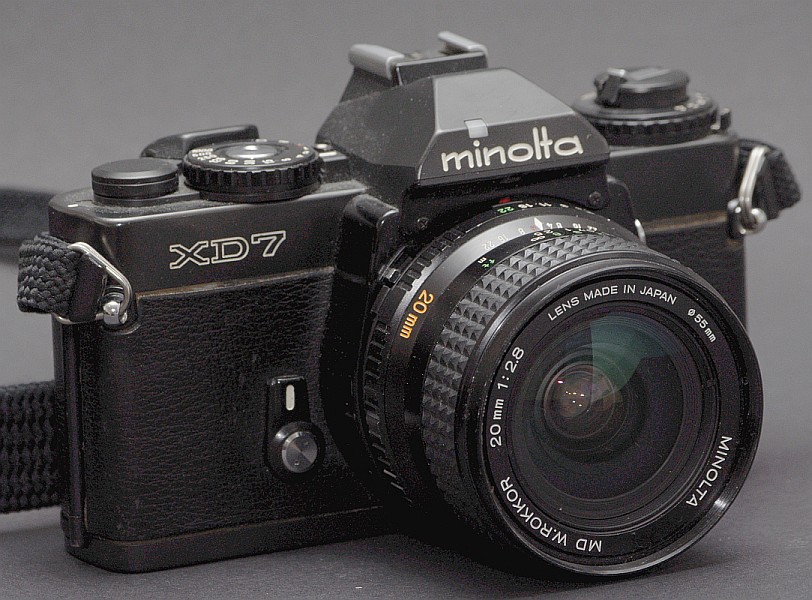
- Leitz Copal metal blade shutter
- Viewfinder shutter
- Mechanical O and B times
- Program, Aperture priority, Shutter priority and Manual modes (although P is not required)
- Time and mode dial style
- Exposure compensation dial position
- Viewfinder information (S/A meter right, judas windows for time and aperture bottom, split image/microprism center)
- XD-S
- Diopter adjustment
- Diopter adjustment
- X500
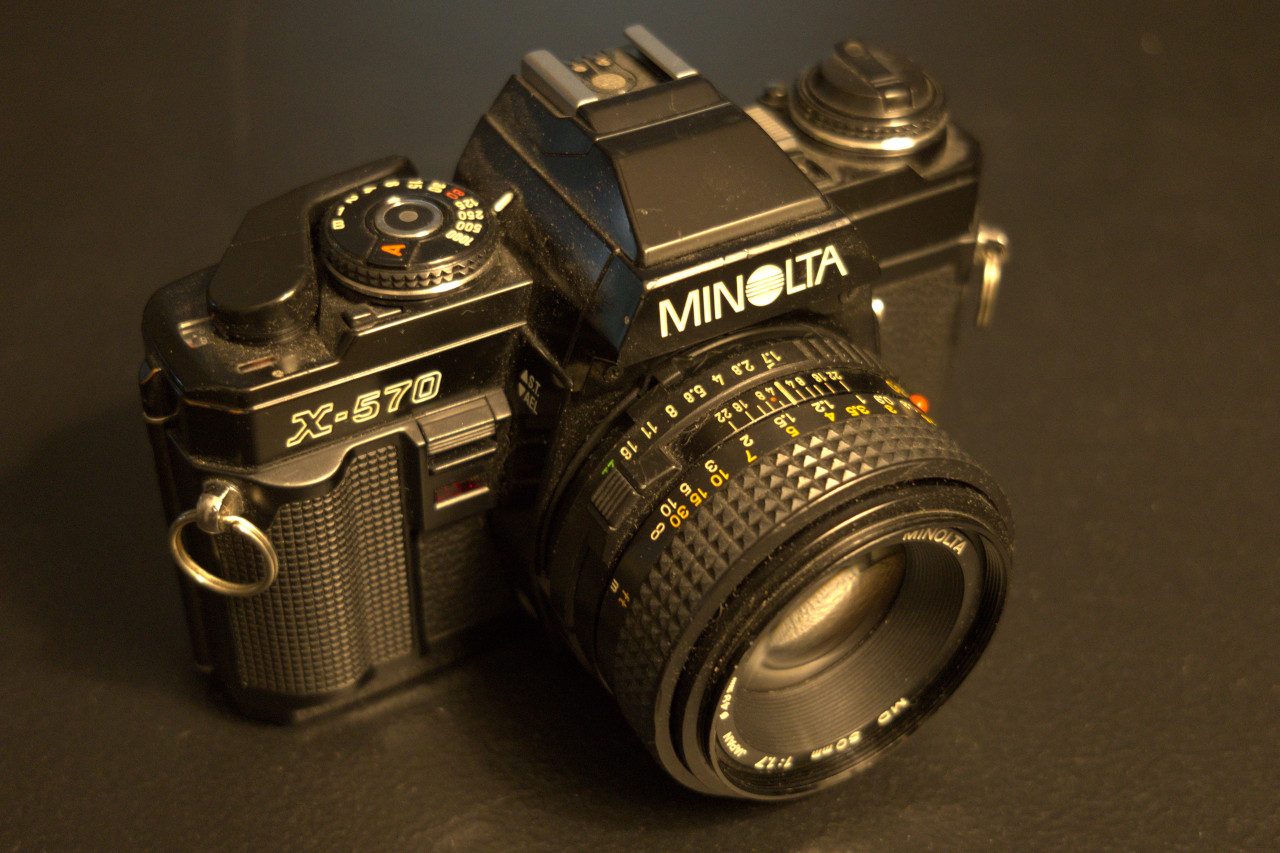
- 12-3200 ISO
- Correct stop-down metering
- Slow Sync flash (although this is closer to abusing a electronics quirk)
- X700

- ISO dial style
- On/Off button placement
- TTL flash metering
- Off-The-Film automatic metering
- Auto Exposure lock/Self timer action
There are some things that no camera really touches upon. Some gripes I have with every model:
- The ISO dial windows are always filled with dust!
- No camera offers X-sync for rear/second curtain.
- Most cameras have either complete lock-up of the automatic modes or none at all: why is there no deeper indent for the auto modes?
- No proper TTL flash control in automatic modes.
SR-T 101, XD-7: Rainer Knäpper, Free Art License
XE: Hiyotada, CC0 1.0
X500: WalkingFoot, CC BY SA 4.0
X700: Martintoy, CC BY 3.0
"""Artistic rendition"""
This is what I would imagine the camera would look like. I merged some elements of the cameras mentioned above in a revolting mess of an image.
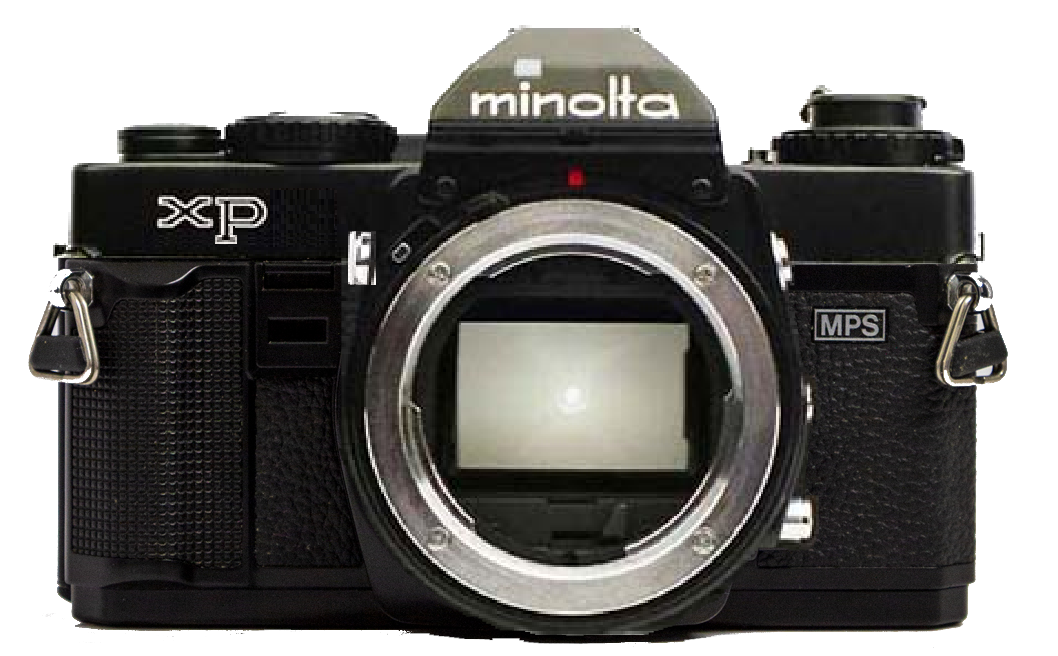 My terrible GIMP attempt.
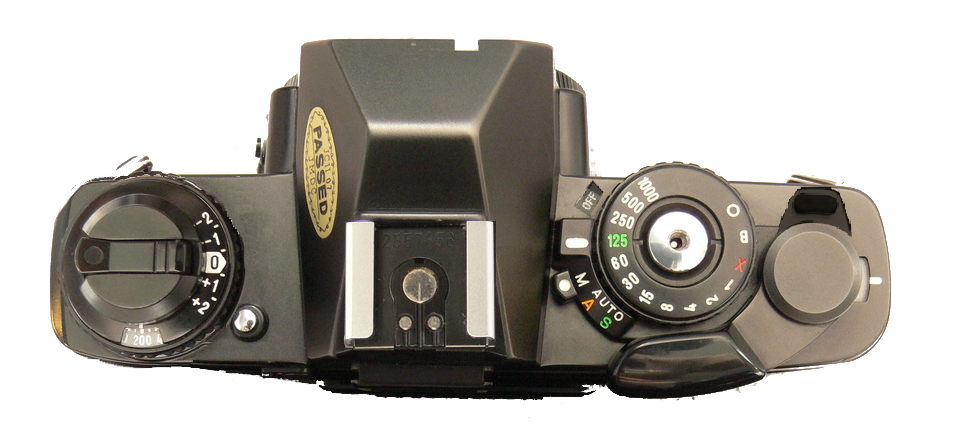 I tried, OK?
Compromise of current models
Alas, no such camera exists. Even the flagships of other brands like Canon and Nikon fall short of the “ultimate” manual focus 135 SLR. I do like the lineup of Minolta bodies, and the lenses even more. That’s actually a good idea for a future post: what lenses I use and why.
The X500 and the X700 might be the camera I might like the most overall, because they contain a lot of the features above, whilst some of the above bullet points are merely subjective, or annoyances I can work with. The only features the X500 and X700 distinctly lack are:
- Mirror Lock-up
- Multiple exposure
- Shutter Priority
I can most certainly live with no mirror lock-up, but the multiple exposure was built into the XD-7 with minimal overhead. Since Program mode is useless to me, shutter priority would have been nice.
The tradeoff between the X700 to the X500 are the loss of a separate exposure compensation dial, a better on/off switch, tactile speed feedback and better control of fill-in flash for a higher ISO range, correct viewfinder information and a slow sync hack.
The tradeoff between the X700 to the XD-7 would be the loss of an On/Off button, TTL flash, slow sync, OTF metering and AE lock for a superior shutter system, excellent viewfinder information, high ISO range and multiple exposure.
I cannot for the life of me decide between the three. I guess the XD-7 leans itself better to creative situations in well-lit areas, the X700 as a easy superior flash machine and the X500 as a general use, no-nonsense camera. I do suspect that the greatest feature set of the XD-7 might win over time. TTL flash might not be a tool I necessarily need, as the balance between natural light and flash light starts to become more important. At that point, I might as well use the auto modes on flashes for both the range automation and ratio setting.
Tangent: flash oddities
Here are some good sources that I used for this summary:
When a subject of a photo is not properly lit, but the backgrounds are, using flash is a nice solution to add in some light to what otherwise be a dimly exposed photograph. Here are some oddities regarding the use of flash in special situations. TTL flash, when used normally with either the X700 or X500, locks the 1/60 speed for the flash. There is no way for a higher speed (although this would be useless) but more importantly, it disables the lower speeds. The only way to bypass this interlock is disconnecting the two data pins on the hot shoe. Moreover, the flash is measured OTF, without a straightforward setting to change the flash intensity. This can lead to overblown highlights or pitch-black backgrounds. This is where fill flash or slow sync can be used! The difference:
- Fill flash can be used for backgrounds in range, where usually the subject is not well lit but the backgrounds are;
- Slow sync is used for backgrounds out of range of the flash, mostly at night.
Using slow sync on backgrounds in range leads to the “swirly time trace” effect, while fill flash on backgrounds out of range will lead to a balance between natural light and flash illumination, without properly lighting up the backgrounds.
Fill flash for the X500 and X700:
- Turn off the flash and meter the aperture for the highlights in the image (usually the background) for a shutter speed of 1/60.
- Turn on the flash and set to TTL.
- Make sure the shadows are in range, compose the picture and take the shot.
A note on fill flash: technically, the X500 and X700, by virtue of the TTL flash metering, always use fill flash. The main difference is that for most of the time, a dark image will be fairly evenly lit by using TTL flash, but the situations here deal with strong contrast differences or backgrounds out of range. The closer the exposure at 1/60 is to an open diaphragm, the more light will be registered from the flash.
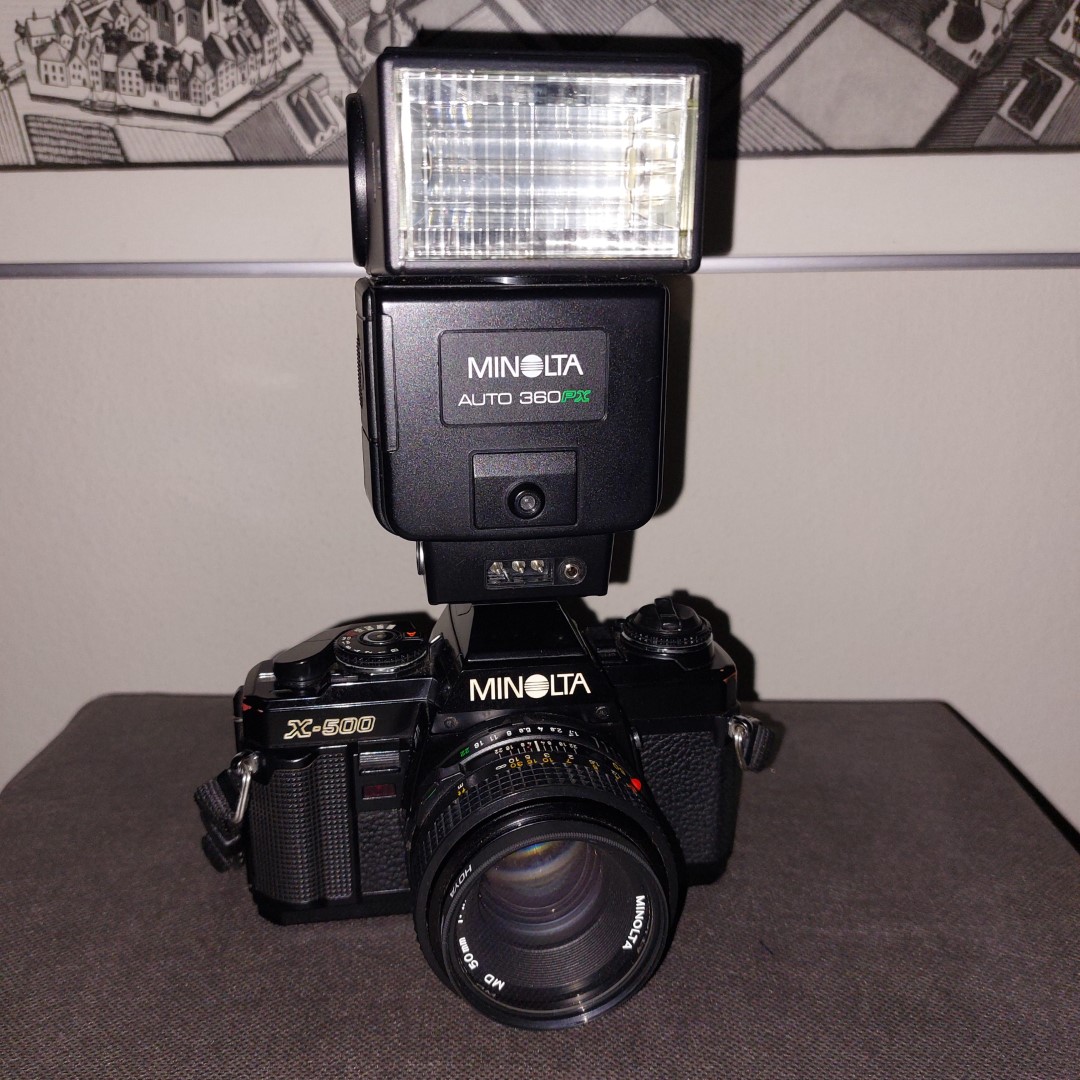
The 360PX manual also has a solution for adjusting the natural/flash light ratio. Although it works on both cameras, the X500 needs a hack:
- Set the camera for an exposure compensation of -1. Use the EC dial on the X700, turn up the ISO sensitivity 1 stop (e.g. 100->200) on the X500. This will cause underexposure of 1 stop.
- Turn off the flash and meter the aperture for the highlights in the image (usually the background) for a shutter speed of 1/125.
- Turn on the flash and set to TTL.
- Make sure the shadows are in range, compose the picture and take the shot.
- Reset the exposure compensation or film speed.
Because the highlights were underexposed 1 stop at 1/125, when the camera flash fires, the forced 1/60 time causes proper exposure on the highlights. Likewise, any other half-stop compensation up or down can be used for a range of 1:4 to 4:1 natural/flash light ratio.
The X500 has a trick, or rather, a hack up its sleeve: slow sync in aperture priority. It is fairly simple:
- Meter the aperture for the shadows in your image (usually the background).
- Press and hold the AE lock button.
- Make sure the planned highlights are in range, compose the picture and take the shot.
Yes, this is hacky. Yes, this does not always lead to properly exposed images, but it’s there. It is neither reliable nor consistent. I wish the X lines had some form of flash compensation. Figuring out a nice balance on film without experience gets expensive fast.
Final thoughts
“Il semble que la perfection soit atteinte non quand il n’y a plus rien à ajouter, mais quand il n’y a plus rien à retrancher.”
“It seems that perfection is finally attained not when there is no longer anything to add, but when there is no longer anything to take away.”
Antoine de Saint-Exupéry
I had a malformed version of this quote in my head, but could not for the life of me remember the original or who said it. This is what I find generative AI to be the best at: transforming partial information that might or might not match the grand theme of the query, into the original information worded in a similar sense. I prompted it with “There is a quote that goes like (…) but I cannot remember the original or who said it. What was the original quote and who said it?” - which is a piece of cake for these models.
I still object to using the dumbass machine that is always wrong for any kind of hard truth or information, as well as the objectionable outsourcing of critical thought on real-world issues. Even when querying for simple information, these models still fail to give mostly useful and hard truth on questions unless you prepend every environment with a “use critical thought and go over your answers” for the risk of AI compliance and lies becomes too great.
That being said: the above quote does not really apply to this small assay. I’d argue that in the specified limits (manual focus 135) there is little to improve on - but what about autofocus? Digital? These cameras have their place and people striving for these features are no less important. But the Minolta XP? Maximalism for the win.